Margaret’s Writings
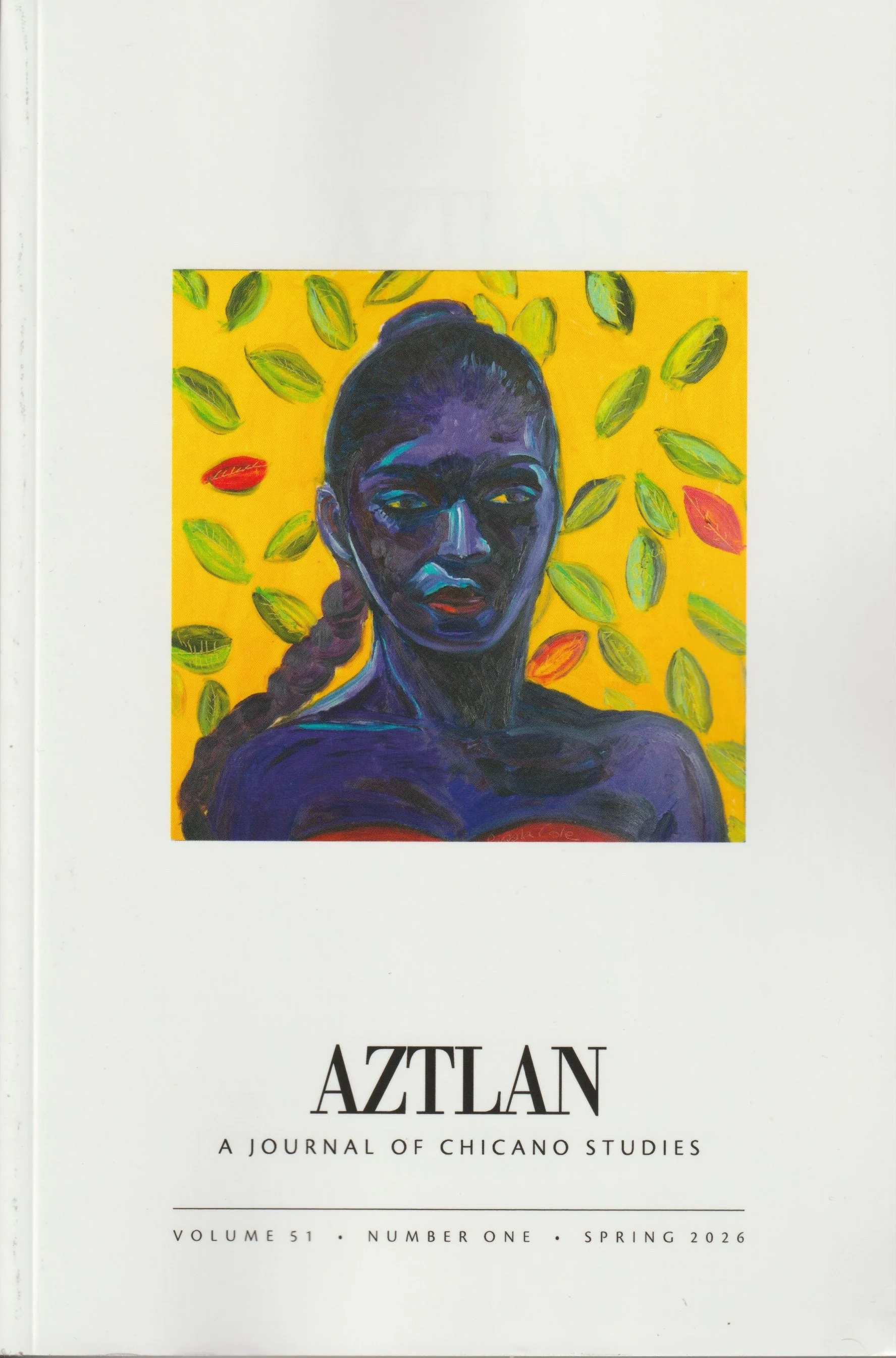
Aztlan A Journal of Chicano Studies. UCLA Chicano Studies Resource Center Journal. “An independent refereed journal dedicated to scholarly research relevant to or informed by the Chicano experience. First published in 1970 and still the premier journal of Chicano studies”.
The journal editors write “The artwork of Margaret Garcia is featured on the cover and in the Artist’s Communiqué. The Los Angeles-based artist reflects on the meaning of her work and the importance of being a “culture warrior” noting that “whether you make permanent objects or paintings or something as ephemeral as a plate of enchiladas that are consumed as soon as they hit the table, you are helping to define our culture, one taco at a time”.
Defining Culture One Taco at a Time Margaret Garcia
When I was six years old, I ran home from school with a crayon drawing and gave it to my father. He took the drawing from me and held it high. Then he picked me up in his arms, swung me around, and declared me an artist. “You are talented and you can be anything you put your mind to,” he said. He gave me an unshakable faith in my ability to be anything I wanted.
During the Great Depression, 1929-39 the United States, a combination of federal, and state, agencies enacted a program of coerced repatriation of people of Mexican descent. It became a mass migration that is referred to as the “Mexican Repatriation.” The estimated number of individuals who returned to Mexico varies widely, reaching two million in some accounts. Of those who left, an estimated 40 to 60 percent were US citizens. My grandfather, Francisco García de Borja was Apache-Yaqui, and my grandmother, Refugia María Marmolejo, who was born in the United States, was Tarahumara. My US-born father, Fernando Francisco García, and his brothers, Gregorio and Enrique, were deported in the early 1930s. None of the children were able to go to school, but Dad taught himself to read and write. Gregorio, the eldest brother, drowned in a flood in Tijuana during the transit. In 1941, my grandmother went to Mexico and found my fifteen-year-old father, his surviving brother, Enrique, and his four cousins, Alfredo, Sally, Connie, and Luisa. My grandmother was able to bring all six home to their birthplace. They all had struggled with the trauma of having been separated from their mothers, who were American citizens. Shortly after returning, my father was attacked by white sailors and stripped of his suit during the Zoot Suit Riots in Downtown Los Ángeles. Whenever Dad was inclined to curse, he would say “God Bless America” because he refused to curse in front of his children. Instead of hating this country, he embraced it all the more.
Dad made me feel as though I was his hope of achievement. My achievement was his. It was an expression of pure love and trust. I imagine that it is the way the Great Spirit feels when we do things right, when we are motivated by the right reasons. In other words, my art practice is something sacred to me. As I look back on the faith that he had in me, and the support I felt from his unconditional love, I understand that he wanted things to be better not only for me but for other children. I now understand how hard he worked for that, and how he had to practice an unbelievable amount of patience to endure the challenges he faced as a man of Mexican descent.
The Value of Perception
As an artist I can talk to you about my use of color and composition, my process and the archival quality of my work, or even its monetary value. For me as a Chicana artist, though, the value is in how my work is perceived. My art is often a reaction to the energy and conversation I have with a sitter, the appreciation for the opportunities I have had, or the environment, community, and cultural foundation I have been given. This is the context of my work. It is the way I define myself, represent what I value in life, and what I celebrate in general. Culture defines who we are, not as stereotypes and cliches but as individuals, each with their own story and contribution to the community. My cultural aesthetics and spiritual beliefs are integral not only to my art but also to the way I speak. It is my accent. Everyone has an accent, and some people listen with an accent. My history is structural, shaping how I understand the world. I am an American. Mexico is on the American continent, so all Mexicans are also Americans. Most are Indigenous and Indigenous mixed with the many cultures of the world—La Raza Cosmica.
I have never sought to produce political art, but I cannot deny that my existence is political, and I cannot escape the dimension in which I currently exist. During the California Mission Period (1769–1833), Indigenous people labored for the missions as peons or slaves. During the Gold Rush era 1849, the genocide of thousands of Indigenous people took place. Some of those who survived, assimilated into the Mexican population, and others went south to escape being killed. 506 tribes existed in California before the Spanish and European settlers arrived. Currently there are 106 tribes that are federally recognized, 88 tribes that have filed for recognition with more than 300 tribes unaccounted for (Dolan Eargle, The Earth is our Mother). It matters to me that the first woman lynched in California was Mexican. Josefa Segovia was eight months pregnant when she was murdered in 1851.
In this year of 2025. I have witnessed a live-streamed campaign of kidnapping and violence directed at people in my community, and it has made me question my “Why.” Why I make art. Why I exist. Why I care. Why it matters. In the end, I realize that through my art I seek to offer refuge from the horrors we are experiencing. Though the content seems nonpolitical, it is intended as a counter to the politics that affect us. It is a way for me and others of my community to face the horrors with dignity. Art making is an undeniable act that challenges the criminalization of my existence and the existence of anyone seen as other. Currently, I find the most impactful political art is being done by anti-ICE dedemonstrators and pro-Palestinian activists.
What I seek most in my work is authenticity. It is the authenticity of our voices and our vision that drives my imagery. My work is not conceptual in that it is not conceived in the mind. Instead, it is born in my heart. I am guided by my desire to evolve and to recognize my love of people and humanity. My DNA expresses a history of Indigenous, Iberian Peninsula, Pilipino, Taino, Sub-Saharan African, Sardinian, Ashkenazi, Neanderthal and more. I respect, honor and love people of different cultures that make up my community because this very diversity runs in my veins. My work expresses my appreciation of what I have, to those I consider part of my community: Black, Brown, Asian, Native and European. We have a shared humanity because we are made of the same star dust. To artists I say that Art is the last great hope because it challenges authority to rethink its perspective and its moral standing. Luis Buñuel has said; “The artists keep an essential margin of nonconformity alive so the powerful can never affirm that everyone agrees with their acts” (New York Times, March 11, 1973).
Do I Know Where I Am? Landscapes and a Sense of Place
My work is about my community, but it is also about the places in which I live, work, and travel, from the parks I enjoy and the taco trucks I visit to the sunsets I see. In my landscapes I convey my connection to Los Angeles, my people and history. What I see is magical, because I have so many memories of my wanderings in the neighborhood: the street where I grew up, the street where my father was born, the schools I attended, and the friends that lived nearby. There are many planets, but this earth is the only earth I know, and it is like a boat. If there is a hole in the boat, we all go down. I am compelled to care.
I agree with artist and scholar Jimmy Centeno, who said to me that “in the philosophy of liberation, that the sunset is the horizon. We always search for a new horizon which translates to hope and a better tomorrow.” Right now, we need hope. Un Nuevo Mestizaje: Portraits
The process of painting a portrait or sitting for a portrait is validating for the artist, the subject, and the community as a whole. My work is populated by individuals who have contributed to the well-being and welfare of my community: immigrants and natives, professionals and skilled workers, teachers and students, filmmakers and photographers, actors and politicians. I push back on stereotypes by presenting portraits of subjects who do not necessarily meet media expectations of what a person should look like. Everyone wants to look good, but in an honest portrayal the person may not be pretty and skinny and have good skin. Sometimes the experience of painting a portrait is about channeling the energy of the subject. And if the painting isn’t dignified, it can misrepresent the subject.
Recently I painted a portrait of another artist, Zelda Harrison. She asked if I had ever been through a famine. I said no. She then proceeded to tell me of her experience as a young girl living in Ghana during a period of famine. When I finished the portrait and showed it to her, she immediately said “I’m not smiling.” I said that would have been pretty weird, if you had smiled at me through that story”. She then understood that it was not about painting another pretty picture but about presenting a document of her life and experience. It is about validation, like the validation sought by those who left their handprints in caves thousands of years ago.
At seventy-four years young, I have expressed myself in many ways, using a variety of forms and media: portraits, landscapes, still lifes, and public art; oil, acrylics, pastels, watercolor, print making, and glass, and I have addressed many topics. Life is short. I don’t have time to be pigeonholed, focusing on one topic, one process, or one perspective, with a steady diet of sameness on the menu. Change is the best thing you have the ability to do. Change your mind. Change your material. Change your perspective. Live life in a way that allows you to experience your true self, because this adventure we are on has a time limit.
Un Nuevo Mestizaje: Portraits
The process of painting a portrait or sitting for a portrait is validating for the artist, the subject, and the community as a whole. My work is populated by individuals who have contributed to the well-being and welfare of my community: immigrants and natives, professionals and skilled workers, teachers and students, filmmakers and photographers, actors and politicians. I push back on stereotypes by presenting portraits of subjects who do not necessarily meet media expectations of what a person should look like. Everyone wants to look good, but in an honest portrayal the person may not be pretty and skinny and have good skin. Sometimes the experience of painting a portrait is about channeling the energy of the subject. And if the painting isn’t dignified, it can misrepresent the subject.
Recently I painted a portrait of another artist, Zelda Harrison. She asked if I had ever been through a famine. I said no. She then proceeded to tell me of her experience as a young girl living in Ghana during a period of famine. When I finished the portrait and showed it to her, she immediately said “I’m not smiling.” I said that would have been pretty weird, if you had smiled at me through that story”. She then understood that it was not about painting another pretty picture but about presenting a document of her life and experience. It is about validation, like the validation sought by those who left their handprints in caves thousands of years ago.
At seventy-four years young, I have expressed myself in many ways, using a variety of forms and media: portraits, landscapes, still lifes, and public art; oil, acrylics, pastels, watercolor, print making, and glass, and I have addressed many topics. Life is short. I don’t have time to be pigeonholed, focusing on one topic, one process, or one perspective, with a steady diet of sameness on the menu. Change is the best thing you have the ability to do. Change your mind. Change your material. Change your perspective. Live life in a way that allows you to experience your true self, because this adventure we are on has a time limit.
Public Art and Exhibitions
In 2000, I completed The Trees of Queen Califas, a commission for the Universal City Metro Subway Station in North Hollywood, California. For this project I worked with architect Kate Diamond and historian Bill Mason as I learned about the history of California and Los Angeles. The work consists of four columns of ceramic tile murals that portray key events leading to the Capitulation of Cahuenga on January 13, 1847, during the Mexican-American War. The Metro station is near the site where the Treaty of Cahuenga was signed by John C. Fremont and Andrés Pico. The treaty ended the fighting between US troops and the Californios. At the close of the war a year later, Mexico formally ceded the territory of California to the United States. Fremont is given credit for helping bring California into the United States. In August 1847, Fremont was court-martialed for several military offences, including mutiny. Although he was convicted of some charges, his sentence was commuted by President Polk in 1848. In 1856, Fremont was the first presidential nominee to run on an antislavery platform. The Trees of Queen Califas reflects the culture and history of California, something I feel profoundly connected to.
What I cherish about our liberties and freedom of expression is manifested in the very work I provide. It is useless to be against hatred and better to be in favor of love; it is useless to be against the authoritarian dictates of a despot and better to be in favor of democracy and civility. To embrace what counters those negative inclinations is more effective because you will never change anyone’s mind by simply screaming. In 2015, I initiated an exhibition called Prayers from Los Angeles at Casa 0101 Theater, which featured work by myself and several other artists. In 2017, I co-curated the exhibition Prayers, Protection, and Resistance at the Muckenthaler Art Center in Fullerton.
Cultural Currency
Whether you make permanent objects or paintings or something as ephemeral as a plate of enchiladas suizas that are consumed as soon as they hit the table, you are helping to define our culture, one taco at a time. By contributing to and defining our culture, you are a culture warrior. The art I make is about awakening my mindfulness about the gifts I am given. Making art is an act of appreciation for this life. It is a prayer and act of resilience, an act of survival and an acknowledgement my existence.
Important occasions, celebrations, and religious ceremonies are often remembered by commissioning retablos and portraits, playing music and dancing, having fiestas. This is art and art is culture. Culture not only defines us but helps us bond with one another. As artist Leo Limón says, “Cultura cura.” Art heals. Celebrate your love, celebrate life, celebrate your very existence. It will piss some people off, but then you will know who supports you. Who celebrates with you? Who perceives the world as you do? The vision that a work of art offers attracts people who may be in agreement and thus fosters a respect or a consensus of conscience. Laura Hernández said to me, when describing her community of Oaxacan artists, “Mamamos de la misma leche.” We are all weaned on the same milk.
Often it is a subtle message that is truly effective. It whispers and haunts you, and it beckons you to take a second look. I am a visual learner and my most effective means of communication is visual. I don’t want visuals that are shouting at me all day long. I want art that compels a conversation, if not with another, then with myself. It is always about how perceptive you are and whether you are secure enough to have that dialog. Art historians can weigh in and dissect the composition, the placement of color, the subject, and even the visceral reaction of a first look. If you have faith in your process, if your expression is skilled in the execution, there is no need to be didactic about the work. Achieving a state of grace in the execution of your talent speaks to the heart and soul of your audience. This type of art is what provides an epiphany, whether about yourself, another person, or the human condition. It is not always due to an individual image. It can be a response to a body of work that resounds with the focus of your life. It is a visual diary.
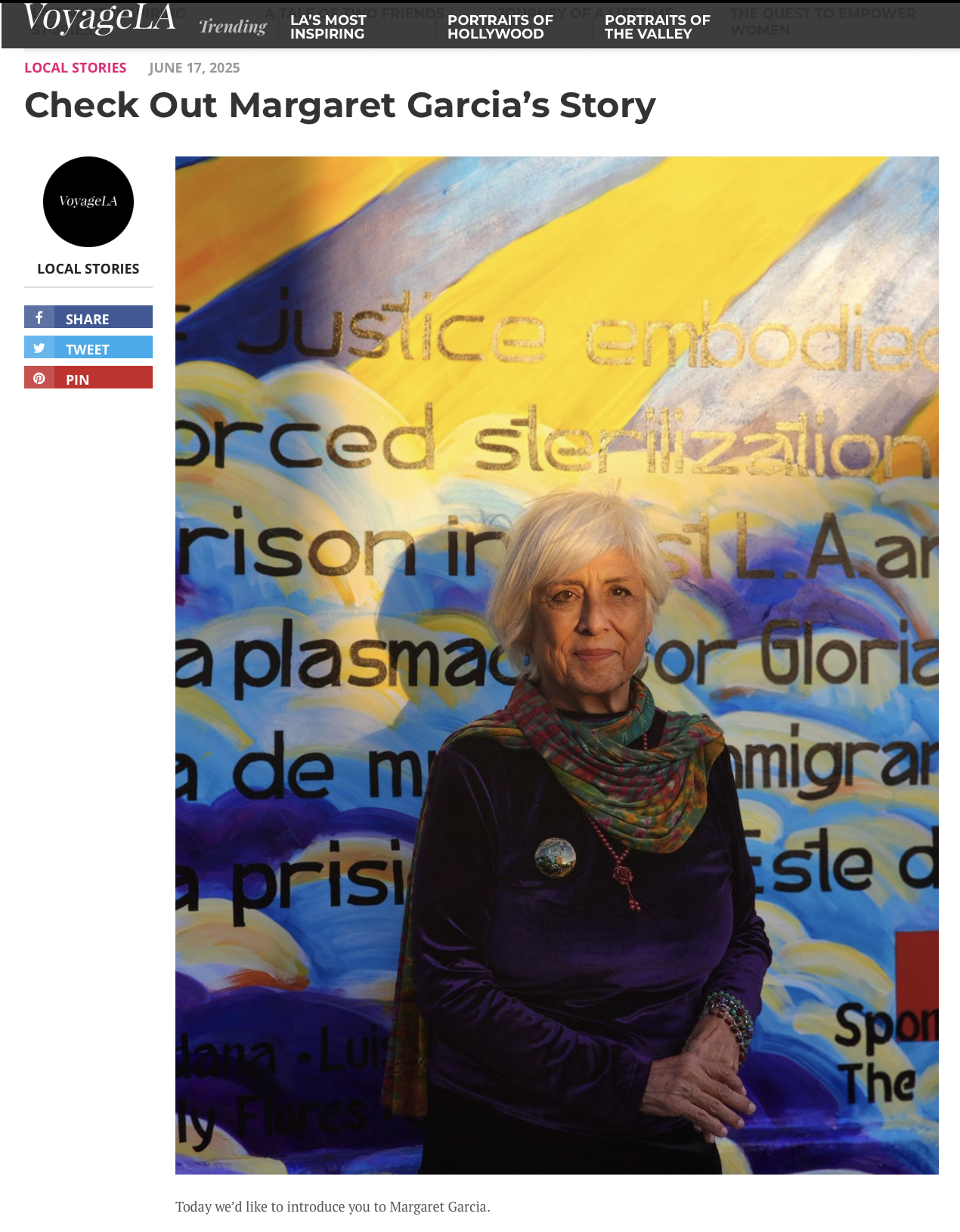
Voyage L.A. Check out Margaret Garcia’s story.
Voyage L.A. columnist publishes an interview with Margaret. Transcript of article below.
Hi Margaret, thanks for sharing your story with us. To start, maybe you can tell our readers some of your backstory.
An avid painter, I began my art career as a muralist and was chosen to participate in the 1984 LA Olympics public art program.
I'm a teacher and a mentor to many young artists, I studied at California State University, Northridge, Los Angeles City College, and the Graduate Fine Arts Program at University of Southern California.
My paintings provide a look into my community through the reflection of the individuals. Although my portraits are not overtly political, over time I have come to realize that their very specificity belies the stereotypes given to any culture by the media.
In addition to portraying my community, my long running "Views from the Pueblo" series captures street scenes and landscapes depicting my Los Angeles neighborhoods of Echo Park, Boyle Heights and Highland Park. I have exhibited in group shows throughout the United States, Mexico and in Europe. In 2022 and 2023, I was featured in solo exhibitions at the Museum of Ventura County and at La Plaza de Cultura y Artes in Los Angeles. In August 2025, I open a solo exhibition at the Muckenthaler Cultural Center in Fullerton, CA. Visit www.margaretgarciastudio.com
Would you say it's been a smooth road, and if not what are some of the biggest challenges you've faced along the way?
Good question. My desire is to mimic life by making marks that create a portrait of another. These are moments where I spend time looking into the eyes of another. Indoctrinated by media - the Lone Ranger and Tonto - to believe in the American Dream, I was led to believe that the enemy looked like me. Yet I was invisible.
Conceived out of wedlock to an undocumented mother, my first breath was a criminal act. My father, born in the United States to an American mother, was deported for being Mexican. My family lived this. My Apache/Yaqui and Tarahumara heritage was not written in English in the record books.
My work says what the first cave paintings said, a declaration of existence, resilience and resistance. True empowerment is authenticity and the ability to define who I am, not as a cartoon, but as a human being. It is easier to kill a cartoon than kill a human being.
The struggle of survival, generational trauma, and sacrifices made to improve life for the next generation motivated me to design economic strategies that create community. Using Art, STEAM, knowledge of regenerative practices and, engaging in collaborative processes that help me mentor as well as throw down the gauntlet in mono-printing, toy making, painting, glass work and cultivating venues that support other artists.
My work inspired the Rhizomes project https://rhizomes.umn.edu/and my art contributed to the Fire Relief Fund, http://lacmaonfire.blogspot.com/2025/01/la-fire-relief-fund.html
Alright, so let's switch gears a bit and talk business. What should we know about your work?
I began my career as a muralist, involved in the murals that celebrated the 1984 Olympics. Identified as one of 24 women artists who have had an impact on Los Angels art, my work consists of oil paintings and pastels saturated with an expressive palette; flat compositional space firmly rooted in the tradition of Mexican Folk art.
My paintings are in the collections of: the Cheech; LACMA; the Laguna Art Museum; Blanton Museum (University of Texas, Austin); University of Texas San Antonio, Universities of California Santa Barbara, Los Angeles and Irvine (Buck Collection); California State University Northridge and Notre Dame University, among others.
I am currently exhibiting at several Museums: The Cheech Center for Chicano Art and Culture (Riverside, CA); ESMoA (Experimentally Structured Museum of Art (Lawndale, CA); The Blanton Museum (University of Texas); the Vincent Price Art Museum (Los Angeles, CA) shown at the Dorothy Chandler Founder's Room at the Music Center, Los Angeles; and the Lancaster Museum of Art and History (in conjunction with LACMA). My Solo Show at the Muckenthaler Cultural Center (Fullerton, CA) opens June 20, 2025.
We'd be interested to hear your thoughts on luck and what role, if any, you feel it's played for you?
I've heard from a wise person - "Luck is opportunity meets preparedness"
All my life, as they say, I've showed up and suited up".
Cliches and cute sayings aside, I've put in the work. I've supported myself and my child as a single mom and a working artist. it is a good thing that, in my younger days, i could paint 6 or 7 paintings a day.
Friendships have played an outsized role in my life. I've believed and still do that when you give, something comes back to you. in the early days when we didn't have a gallery offering us a show, we'd create one for ourselves.
i try to say yes. I mentor younger artists. I host weekly oil painting workshops in my studio. I support other artists by showing up at their openings. I recommend younger artists to curators and galleries. I keep my word. I am blessed to have a "posse" of artists with whom i work and show with regularly.

Los Angeles County Museum on fire is a Los Angeles-based art blog offering latest information on area museums and important collections. This blog entry in early 2025 spreads to word about the L.A. County Arts Community Fire Relief Fund. Margaret’s Fire from Within illustrated this notice,
Why I Paint Fire 01.23.2025
“I paint FIRE because in it’s terrible beauty it is mesmerizing and fierce, all-consuming and electrifying. It is painful and takes no hostages. It is in my nature to confront what devastates me most. That is how I know to move forward.
When I met Rhett Beavers, a landscape architect, he said to me; ‘the earth is a repository of our history’. So I married him. Our relationship fueled these paintings of fire and my knowledge of climate change and regenerative practices that are actionable and life saving.
I paint fires in my effort to bring attention to inform and motivate people to understand the dynamics of our environment and advocate for behavior that helps address climate change as and perhaps save lives.
I was born and grew up in Los Angeles California. Los Angeles sits in basin that the indigenous called valley of the smoke. Wild fires are part of the natural conditions of this chaparral. A chaparral is not desert as the Department of Water and Power has promoted.
According to Wikipedia: - Chaparral is a dense, shrubland plant community found in California, northern Mexico, and southern Oregon. It's characterized by hot, dry summers and mild, wet winters, and is shaped by infrequent, intense fires. Chaparral is known for its complex biodiversity and dense foliage…
The word chaparral is a loanword from Spanish chaparro, meaning place of the scrub oak, which itself comes from a Basque word, txapar, that has the same meaning.
People move here from the East coast and places that are verdant and green, not knowing that the spectacular views of the oceans, views of the valleys and urban views that twinkle with lights are match boxes that a light in combustible spontaneity that are fed by Santa Ana winds.
The ordinances that control the building and safety are much more concerned with landslides and mudslides which often occur during the rains after the fires have consumed the vegetation that holds the ground.
Is this a part of climate change? Yes it is. However we can slow the erosion of our hills. The people need to use systems of grey water and pool water to irrigate during these breakout fires. Zeroscaping our gardens with succulents and ice plants, plants that wither and don’t combust. The desire for green lawns, use too much of our precious water. Conservation of water is only part of the answer.
I would advocate cisterns, swimming pools, grey water reserves be part of the building codes that build in these areas.
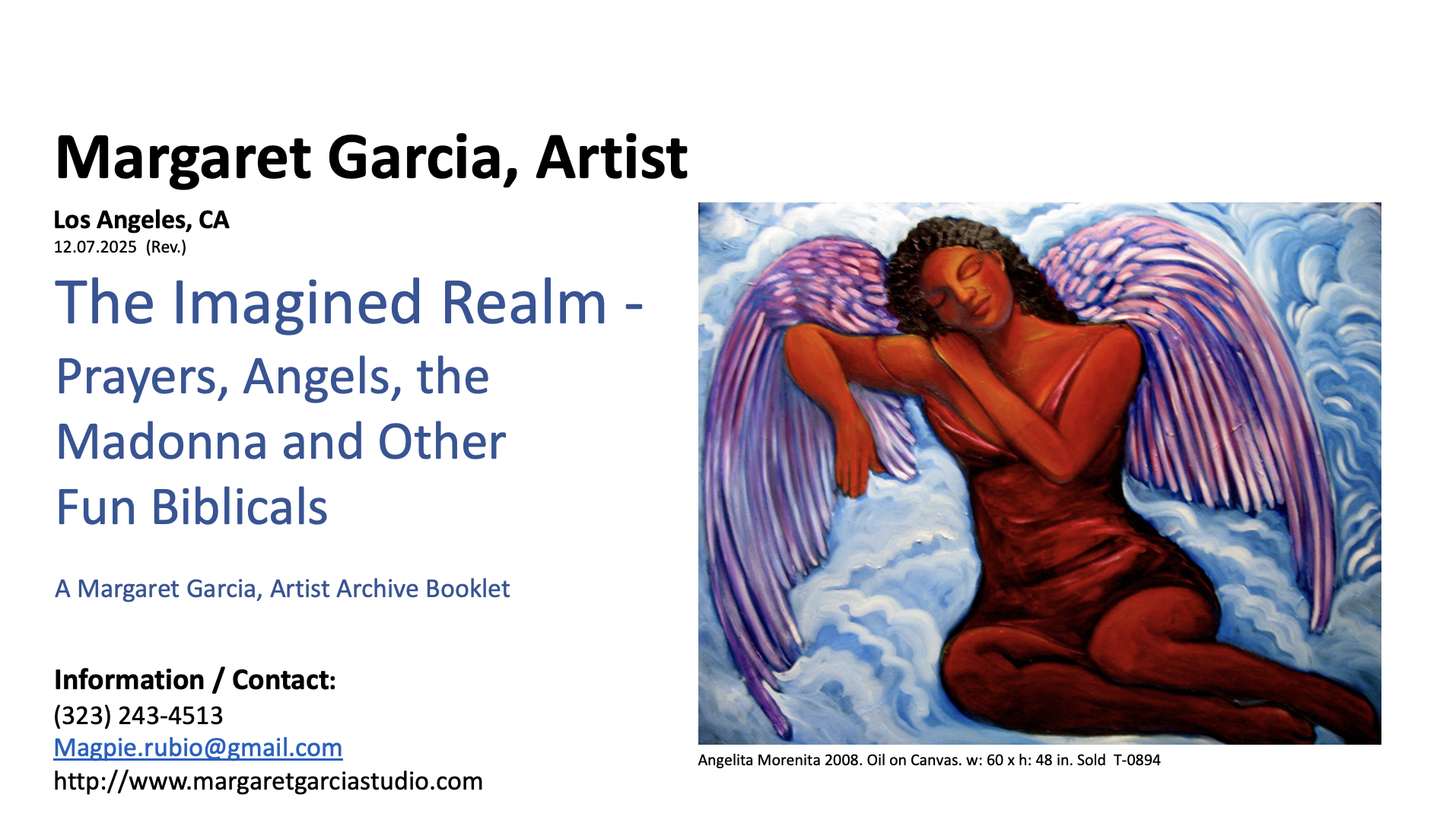
One of the 50+ archive booklets comprisingMargaret’s working Catalogue Raisonné created from her archive comprising a 40+ year chronology, a collection of quotes by and about Margaret and a visual archive of more than 2232 (and counting) artworks by Margaret. The archive is named the Margaret Garcia Artist Archive, This archive is continuously updated and is available for consultation.